

How To Choose The Correct Bolt Grade for Strength
Views: 325 Author: Site Editor Publish Time: 2026-03-15 Origin: Site


Introduction
Selecting the right bolt is more than just grabbing a piece of metal from a bin. It is a critical engineering decision that affects the safety and longevity of any structure. Whether you are working on an automotive engine or a massive industrial bridge, the strength of the bolt determines if the joint holds or fails under pressure. Many people find the grading systems confusing because they mix different standards like SAE, ASTM, and ISO.
In this guide, we will break down the science of choosing the correct grade for your specific strength requirements. We will look at how a heavy duty application differs from a light-weight project and why choosing a Stainless steel option isn't always about strength, but often about corrosion. By the end of this expert insight, you will know exactly how to read head markings and match them to your load calculations.
Understanding the Fundamentals of Bolt Strength Grading
The "grade" of a bolt refers to its mechanical properties, specifically its tensile strength and yield strength. Tensile strength is the maximum stress it can withstand while being pulled before it breaks. Yield strength is the point where it permanently deforms. If you exceed the yield strength, the bolt stretches like taffy and will never return to its original shape, even if you remove the load.
Different industries use different marking systems. In North America, the SAE (Society of Automotive Engineers) system uses radial lines on the head. In Europe and most of the world, the Metric flange or standard metric system uses numbers like 8.8, 10.9, or 12.9. These numbers are not random; they represent a mathematical formula of the material's capabilities. Choosing the wrong grade often leads to catastrophic "brittle failure" if the material is too hard, or "ductile failure" if it is too soft.
Deciphering Metric vs. SAE Grade Markings
To choose for strength, you must speak the language of the manufacturer. A Precision CNC machined fastener will always have these markings clearly stamped. If a bolt has no markings, it is generally considered "Grade 2" or "Property Class 4.6," which is only suitable for non-critical, low-strength uses.
The Metric Property Class System
Metric grades use two numbers separated by a dot. The first number represents 1/100th of the nominal tensile strength in Megapascals ($MPa$). The second number represents the ratio of yield strength to tensile strength. For example, a Metric flange bolt marked 10.9 has a tensile strength of $1000 MPa$ ($10 \times 100$) and a yield strength that is $90\%$ of that total ($900 MPa$).
The SAE (Inch) Grading System
The SAE system uses marks or lines.
Grade 2: No lines. Low carbon steel.
Grade 5: Three radial lines. Medium carbon steel, quenched and tempered.
Grade Grade 8: Six radial lines. heavy duty use, high strength alloy steel.
| Grade Standard | Head Marking | Tensile Strength (approx. PSI) | Common Application |
| SAE Grade 2 | No Lines | 60,000 - 74,000 | Household hardware |
| SAE Grade 5 | 3 Lines | 120,000 | Automotive suspension |
| SAE Grade 8 | 6 Lines | 150,000 | heavy duty machinery |
| Metric 8.8 | "8.8" | 116,000 | General engineering |
| Metric 10.9 | "10.9" | 150,000 | Structural steel joints |
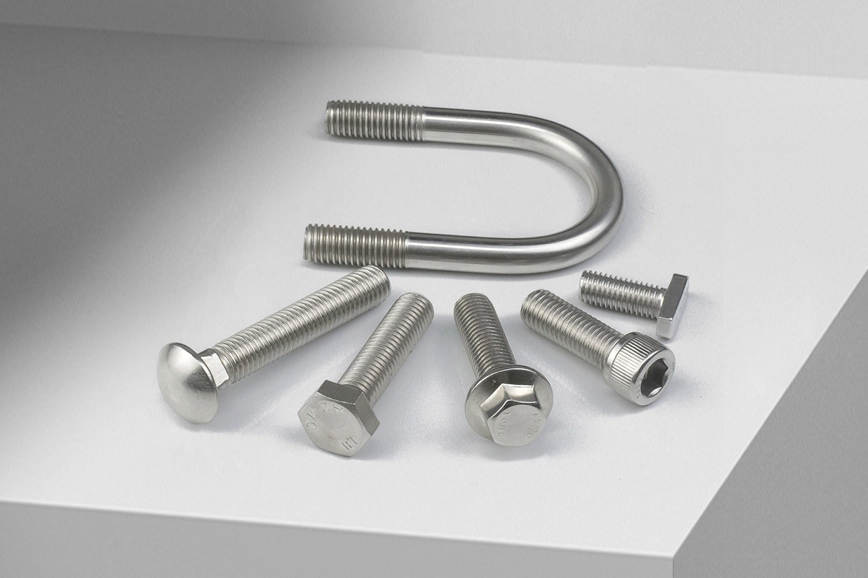
When to Prioritize Stainless Steel Over Carbon Steel
A common mistake is assuming Stainless steel is the strongest choice. In reality, a standard Stainless steel bolt (like 304 or 316 grade) is often weaker than a Grade 8 or Class 10.9 carbon steel bolt. Stainless steel is chosen for its chemical resistance, not its raw mechanical power.
If your project is outdoors or in a marine environment, you need that corrosion resistance. However, if you are building a high-stress engine component, a Stainless steel fastener might "gall" or seize up under high torque. For strength-critical applications in corrosive areas, engineers often look for specialized Precision CNC machined alloys or coated high-strength carbon steels. We always suggest checking the specific alloy sub-grade (like A2-70 or A4-80) to ensure the strength meets your safety margins.
Heavy Duty Applications: Choosing for High Load and Vibration
In heavy duty environments, such as construction equipment or mining, the bolt must withstand more than just static weight. It faces "fatigue," which is the stress of being loaded and unloaded thousands of times. A T head bolt or a specialized structural fastener is often used here because the head shape allows for better torque distribution.
Material Selection for High Stress
For extreme strength, we look at alloy steels that have been heat-treated. The tempering process makes the metal less brittle. While a Class 12.9 bolt is the strongest common metric grade, it can be susceptible to hydrogen embrittlement. Therefore, for most heavy duty vibrations, a 10.9 is often the "sweet spot" because it offers high strength with enough toughness to absorb shocks without snapping.
Torque and Preload
Strength isn't just in the metal; it’s in the installation. A bolt works like a very stiff spring. When you tighten it, you "preload" it. If the grade is too low, you cannot apply enough torque to create the clamping force needed to keep the joint from sliding. We always recommend using a calibrated torque wrench for any grade above SAE 5 or Metric 8.8.
Specialty Bolts: T Head and Metric Flange Advantages
The shape of the bolt often dictates how well it performs under specific stress types. Not all strength comes from the metallurgy; some comes from the geometry of the fastener.
The Advantage of the Metric Flange Bolt
A Metric flange bolt features an integrated washer under the head. This increases the surface area of the clamping force. By spreading the load, it prevents the material being fastened from crushing or deforming. This is vital when the bolt grade is much stronger than the material it is holding together. It keeps the joint tight even under thermal expansion.
Precision CNC Machined T Head Bolts
T head bolts are frequently used in slotting systems and heavy machinery. Because they are often Precision CNC machined, the tolerances are incredibly tight. This means the load is distributed evenly across the threads. In high-strength scenarios, uneven thread engagement is the leading cause of failure. A Precision CNC machined thread ensures that every single peak and valley of the screw carries its fair share of the weight.
Environmental and Temperature Factors in Grade Selection
Strength is dynamic. A bolt that is strong at room temperature might fail in extreme heat or bitter cold. This is a crucial "Expert Insight" for those in the aerospace or oil and gas industries.
High-Temperature Strength
As temperature rises, metal softens. If you use a standard Grade 5 bolt in an exhaust manifold, it will eventually stretch and lose its clamping force. You need materials specifically rated for high-temp strength, such as A286 or Inconel. These are often Precision CNC machined to handle the specific expansion rates of the assembly.
Cold Temperature Brittleness
In very cold climates, high-strength carbon steel can become brittle like glass. While a Grade 8 bolt is strong, it might snap under a sudden impact in sub-zero temperatures. In these cases, we often shift toward specific Stainless steel alloys or nickel-heavy steels that maintain their "impact toughness" in the cold. Always consider the lowest possible temperature your bolt will encounter during its service life.
How to Calculate the Required Bolt Strength
How do you move from "guessing" to "knowing"? You must calculate the total load. This involves looking at both "Shear Stress" (force pushing sideways) and "Tensile Stress" (force pulling apart).
Step-by-Step Selection Process
Determine the Load: Calculate the weight or pressure the joint must hold.
Apply a Safety Factor: Experts usually multiply the load by 2 or 5. If the joint must hold 1,000 lbs, choose a bolt setup that can hold 5,000 lbs.
Check the Shear Area: If the force is sideways, the strength depends on the diameter of the unthreaded shank of the bolt.
Select the Grade: Match your required $PSI$ or $MPa$ to the charts provided by SAE or ISO standards.
Example Calculation (Simplified)
If you have a heavy duty bracket requiring 100,000 PSI of tensile strength, an SAE Grade 2 (60k PSI) will fail. You must step up to at least a Grade 5 (120k PSI) to ensure a margin of safety. If the environment is vibrating, you might even move to Grade 8 to prevent fatigue failure over time.
Common Mistakes When Choosing Bolt Grades
Even pros make mistakes. The most common error is "over-grading." You might think, "Why not just use the strongest bolt available for everything?" This is dangerous for two reasons. First, higher-grade bolts are more brittle. If the structure shifts, a Grade 2 might bend (giving you a warning), while a Class 12.9 might snap instantly without warning.
Second, there is the risk of "galvanic corrosion." If you put a very high-grade carbon steel bolt into an aluminum frame, the difference in the metals will cause the aluminum to corrode rapidly. Another mistake is ignoring the nut. Your nut must always match or exceed the grade of the bolt. If you put a Grade 2 nut on a Grade 8 bolt, the threads on the nut will simply strip long before the bolt reaches its proper tension.
Conclusion
Choosing the correct bolt grade for strength is a balance of metallurgy, environment, and geometry. You must look past the shiny finish and read the markings on the head. Remember that strength is not just about resisting a break; it is about maintaining clamping force over years of vibration, temperature swings, and load cycles. Whether you choose a Metric flange for its load-spreading abilities or a Precision CNC machined T head for a specific industrial track, ensure the grade matches the mission.
FAQ
Q: Can I replace a Grade 5 bolt with a Grade 8 bolt?
A: Usually, yes, but it is not always better. A Grade 8 bolt is stiffer and more brittle. If the joint requires some flexibility or "ductility," the Grade 8 might snap where the Grade 5 would have bent.
Q: How can I tell if a bolt is Stainless steel or just zinc-plated?
A: Stainless steel is usually non-magnetic (or only slightly magnetic) and will be marked with codes like "A2" or "304." Zinc-plated carbon steel is very magnetic and will have the radial lines or numbers indicating its grade.
Q: Does the thread pitch (Fine vs. Coarse) affect strength?
A: Yes. Fine-thread bolts have a larger "stress area" because the threads are shallower. This generally makes them slightly stronger in tension than coarse-thread bolts of the same grade.
Expert Fastener Manufacturing and B2B Strength Solutions
As a leading professional fastener manufacturer, we specialize in delivering high-performance solutions for the most demanding B2B industrial applications. Operating out of our advanced factory in Jiaxing, China, we leverage over two decades of expertise to produce Precision CNC machined fasteners that exceed international standards. Our facility is not just a production line; it is a center of technical excellence where we manufacture everything from heavy duty structural bolts to specialized T head and Metric flange components.
We understand that for our B2B clients, consistency and material integrity are non-negotiable. That is why we maintain rigorous quality control protocols, ensuring that every bolt leaving our doors—whether it is Stainless steel or high-tensile carbon steel—meets the exact strength grade specified. From customized automotive components to large-scale construction fasteners, we have the manufacturing strength and technical depth to support your most complex projects with reliability and competitive pricing.
